Your Brand Is an Asset, Not an Expense: Making the Financial Case for Strategic Design Investment
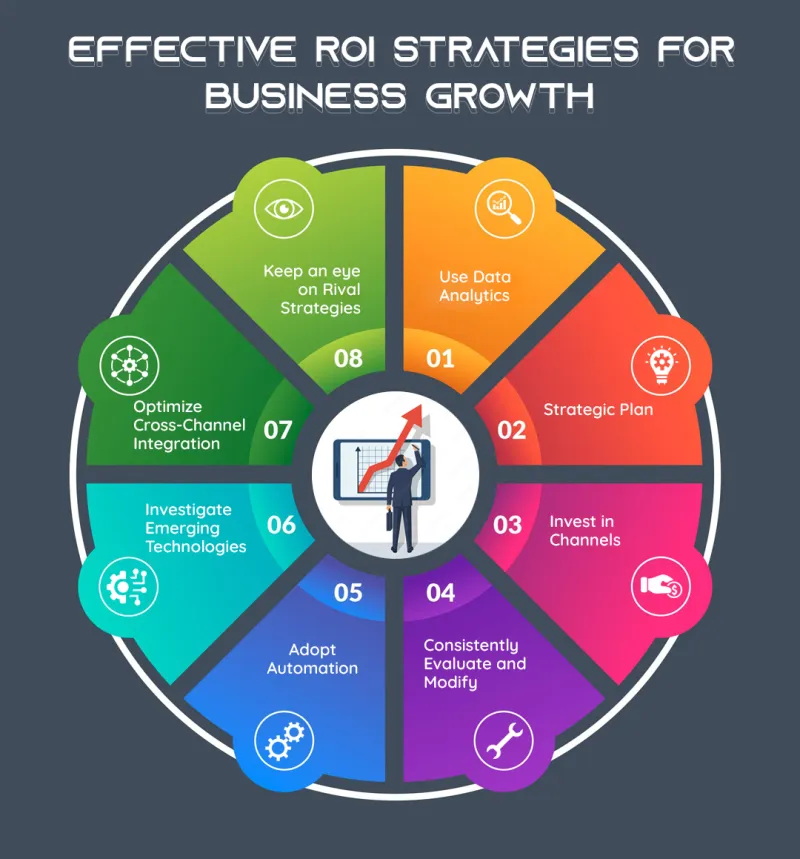
Photo: brand investment business growth strategy ROI financial planning, via digitalexpertsindia.com
Consider two businesses in the same industry, serving the same demographic, with comparable products and pricing. One has invested consistently in its visual identity — cohesive brand system, professional design across every customer touchpoint, a clear and recognizable aesthetic. The other has patched together a brand over the years: a logo from one era, a website from another, marketing materials that barely feel related to one another.
Which one commands a price premium? Which one earns customer trust faster? Which one spends less acquiring each new customer because its reputation precedes it?
The answer is obvious. And yet, the second scenario describes the majority of small and mid-sized American businesses — not because their founders lack ambition, but because design has never been framed to them as an investment with measurable returns. It has been framed as a cost. A necessary evil. Something you spend on when you have money left over.
That framing is costing businesses far more than any design project ever would.
The Design Debt Problem
In software development, "technical debt" refers to the accumulated cost of quick fixes and shortcuts taken in lieu of proper solutions. The debt doesn't disappear — it compounds. Every patch added to a flawed foundation makes the eventual correction more expensive and more disruptive.
Design debt operates identically. Every year a business defers a brand refresh, continues distributing inconsistent marketing materials, or applies a new typeface and color palette to a campaign without system-level thinking, it adds to a liability that will eventually demand repayment — usually at the worst possible moment.
The symptoms are recognizable: a sales team that struggles to explain what makes the company different, a website conversion rate that underperforms industry benchmarks, a customer acquisition cost that creeps upward despite increased ad spend. These are not marketing problems in isolation. They are, at least in part, design problems.
Strategic Design Compounds Like Real Estate
Here is the reframe that changes everything for businesses willing to consider it: a well-built brand system is not unlike a well-located property. It appreciates in value over time. It generates returns that are difficult to attribute to any single transaction but are undeniable in aggregate. And neglecting it — failing to maintain it, allowing it to deteriorate — destroys value that took years to build.
Consider the trajectory of brands that have made deliberate design investments at strategic inflection points. When Airbnb undertook its comprehensive rebrand in 2014 — introducing the now-ubiquitous "Bélo" symbol and a cohesive visual language — the company was preparing for a period of aggressive international growth. The design investment was not made because the old brand was broken. It was made because the leadership understood that a fragmented, inconsistent visual identity would become a liability at scale. The rebrand preceded some of the company's most significant growth years.
On a smaller scale, regional American brands across industries from food and beverage to professional services have demonstrated the same pattern: deliberate investment in visual identity, followed by measurable improvements in customer acquisition, retention, and pricing power. The design investment didn't cause all of that growth — but it created the conditions for it.
Why Decision-Makers Resist Design Investment
The resistance is understandable. Design ROI is notoriously difficult to isolate. A new brand system doesn't come with a guaranteed revenue multiplier attached. And in an environment where every budget line is scrutinized, spending six figures on visual identity work feels speculative in a way that a paid search campaign does not.
But this comparison is itself flawed. Paid search generates traffic for as long as you pay for it. A strong brand system generates trust, recognition, and preference indefinitely — and those qualities reduce the amount you need to spend on paid channels over time. The McKinsey Design Index, which has tracked design investment across hundreds of companies over multiple years, found that design-led businesses outperformed industry benchmarks on revenue growth by as much as 32 percent over a five-year period. That is not a rounding error.
The challenge is communicating this in language that resonates with the CFO as much as the CMO.
A Framework for Justifying Design Budgets
For design leaders and agency partners making the internal case for meaningful investment, the following framework provides a structured approach:
Baseline the cost of inconsistency. Before proposing a design budget, quantify what fragmentation is currently costing. How many hours does the marketing team spend recreating assets from scratch because no system exists? What is the estimated impact of a below-average conversion rate on annual revenue? What is the customer acquisition cost trend over the past three years?
Reframe design as infrastructure. In the same way that a business wouldn't debate whether to invest in its CRM system or its physical premises, design infrastructure — brand guidelines, a coherent visual system, professional templates — should be presented as operational necessity rather than creative luxury.
Project the compounding effect. A brand system built correctly today generates value over a three-to-five-year horizon without requiring proportional reinvestment. Model that return explicitly. If a $75,000 brand investment improves conversion rate by two percentage points and that improvement holds for four years, the math often becomes straightforward.
Benchmark against competitors. In most categories, the visual quality gap between market leaders and challengers is visible to any objective observer. Showing decision-makers where their brand sits relative to the competition — and what closing that gap has historically meant for peer companies — is often more persuasive than any abstract ROI argument.
The Opportunity Cost of Waiting
Every quarter a business defers genuine design investment is a quarter in which a competitor is building brand equity, earning customer trust, and compounding the recognition that makes future growth cheaper and faster. Design is not a cost center that drains resources. It is a growth asset that, managed strategically, pays dividends long after the invoice is settled.
At DesignBB, this is not a theoretical position — it is the foundation of every client engagement we undertake. Bold brands are not built by accident, and beautiful design is not a luxury reserved for companies with unlimited budgets. It is a disciplined, strategic choice that delivers real results. The question is not whether your business can afford to invest in design. The question is how long it can afford not to.