Mirror, Mirror: A No-Excuses Design Audit Framework Every Brand Should Run Right Now
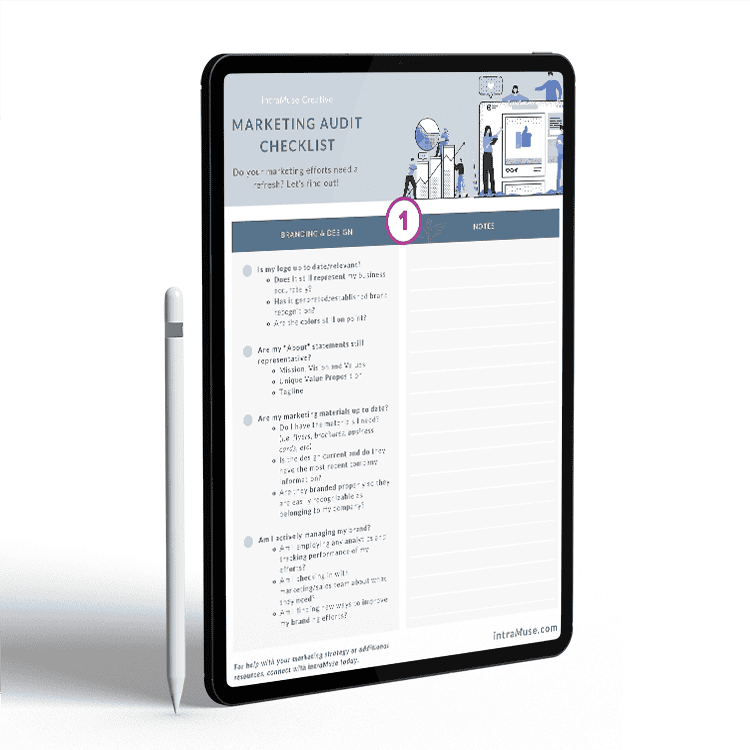
Photo: brand audit checklist marketing team reviewing design materials on table, via intramuse.com
The Brand You Think You Have vs. the Brand You Actually Have
There is a particular kind of discomfort that comes from looking at your own brand with fresh eyes. Not the eyes of someone who built it, approved it, or defended it in a budget meeting—but the eyes of a first-time customer encountering it on a crowded search results page or a busy trade show floor.
Most brands never attempt this exercise. The reasons are understandable: internal familiarity creates blind spots, leadership has emotional investment in past decisions, and frankly, nobody wants to discover that the logo refresh from 2017 has quietly aged into irrelevance. But avoidance is expensive. Design inconsistencies compound over time, and what starts as a minor typographic deviation or an off-brand social media template eventually hardens into a credibility problem that customers sense before they can name it.
A design audit is not a rebrand. It is not an indictment of past decisions. It is, at its core, an honest inventory—a structured process for understanding the gap between the brand you intend to project and the brand your audience actually experiences.
What a Design Audit Actually Covers
Before walking through the framework, it is worth clarifying scope. A comprehensive design audit examines four primary domains:
Visual consistency — Are your typefaces, color palette, logo usage, and graphic language applied uniformly across every customer touchpoint?
Relevance and currency — Does your visual identity reflect current design sensibilities, or does it carry the unmistakable timestamp of the decade it was created?
Strategic alignment — Does your design system reinforce your brand's positioning, or has it drifted away from the values and market segment you are actively pursuing?
Functional performance — Are your design assets working hard enough? Are they legible, accessible, and optimized for the channels where your audience actually encounters them?
Each domain requires a different lens, and skipping any one of them produces an incomplete picture.
Step One: Gather Everything Before You Judge Anything
The first phase of an honest audit is purely archaeological. Collect every branded asset you can locate—not just the ones in your approved asset library, but the ones that actually exist in the wild. Pull your website, every active social media profile, email templates, sales decks, trade show materials, packaging, invoices, and any co-branded content produced with partners.
What most teams discover at this stage is sobering: there are typically two or three unofficial brand systems running in parallel. The approved guidelines exist in a PDF somewhere. The actual design language lives in a patchwork of inherited templates, departmental workarounds, and one-off vendor productions that nobody fully controlled.
Document what you find without editing or excusing it. The goal is a complete picture, not a curated one.
Step Two: Apply the Consistency Checklist
With your full asset inventory in hand, work through the following checklist systematically. This is most effective when conducted by someone with enough distance from daily brand management to evaluate objectively—a new team member, a cross-departmental colleague, or a trusted external advisor.
- Logo usage: Is the correct logo version appearing in every context? Are there unauthorized variations, stretched proportions, or legacy versions still in circulation?
- Color application: Does your palette hold across digital and print? Are there rogue colors appearing in presentations or social graphics that have no basis in your official system?
- Typography: Are your designated typefaces the ones actually being used? Are web-safe substitutions creating an unintended visual disconnect?
- Imagery style: Does your photography and illustration maintain a consistent tone, subject matter, and production quality? Or does it look like it was sourced from three different stock libraries by three different people with three different aesthetics?
- Voice and visual hierarchy: Across your written and designed content, is there a coherent relationship between how information is organized and how it looks?
Score each category on a simple three-point scale: consistent, partially consistent, or inconsistent. Resist the urge to rationalize. A "partially consistent" score that you talk yourself into calling "consistent" is just expensive self-deception.
Step Three: Test Against Your Current Positioning
Brands evolve strategically faster than their visual identities tend to follow. A company that repositioned itself as a premium service provider three years ago may still be carrying design language that signals affordability and volume. A technology firm that has moved upmarket into enterprise sales may be presenting itself with a visual identity that still reads as a scrappy startup.
For this phase, write down three to five adjectives that represent your brand's current strategic positioning—not aspirational language, but the actual market position you are actively competing for. Then ask a small group of people unfamiliar with your brand to describe the personality they perceive from your materials using their own words.
The gap between those two lists is your alignment deficit. It is also one of the most actionable outputs a design audit can produce.
Step Four: Evaluate Channel Performance
Every design element needs to earn its keep in the specific environments where it operates. A logo that reads beautifully in print may dissolve into illegibility as a 32-pixel favicon. A color palette that commands attention on a billboard may fail entirely on a mobile screen under direct sunlight.
Walk through each major channel your brand occupies and ask a direct question: Is the design working here, or is it merely present? Check load times on image-heavy pages. Test contrast ratios against WCAG accessibility standards. View your email templates on both desktop and mobile at actual display sizes. Pull up your social profiles on a phone and evaluate them the way a distracted user scrolling at speed would.
This phase often surfaces quick wins—small, low-cost corrections that meaningfully improve how your brand performs without requiring a broader redesign.
Step Five: Synthesize and Prioritize
A completed audit will almost certainly surface more issues than any team can address simultaneously. The final step is triage: categorizing findings by severity and effort, and building a prioritized remediation roadmap.
Divide your findings into three buckets. The first contains critical inconsistencies that are actively undermining credibility or creating confusion—these require immediate attention. The second contains strategic misalignments that are costing you positioning—these belong in your next planning cycle. The third contains optimization opportunities that would sharpen performance over time—these can be addressed incrementally.
The audit itself is not the end. It is the beginning of a more intentional relationship with your brand's visual identity—one built on evidence rather than assumption, and on honest self-assessment rather than comfortable familiarity.
The brands that do this work, even when it is uncomfortable, are the ones that show up looking like they mean it. In a marketplace where first impressions are measured in milliseconds, that discipline is not optional. It is competitive advantage.