The Hidden Price Tag on Brand Inconsistency: A Framework for Measuring What Scattered Design Is Actually Costing You

Photo: TheAHL, CC BY 2.0, via Wikimedia Commons
When "Good Enough" Stops Being Good Enough
There is a particular kind of organizational blind spot that afflicts growing businesses almost universally. It does not announce itself. It accumulates gradually, one rushed asset at a time—a social media graphic produced without referencing the style guide, a sales deck updated by someone who approximated the brand colors from memory, a new landing page built by a developer who never received the typography specifications. Individually, each compromise seems trivial. Collectively, they constitute something with a real financial consequence.
The concept of design debt—borrowed from the software development world's notion of technical debt—describes exactly this accumulation. Every shortcut taken in the interest of speed or convenience is, in effect, a loan against your brand's future credibility. And like any debt, it accrues interest. The longer it goes unaddressed, the more expensive the eventual reckoning becomes.
Understanding that cost is not an exercise in aesthetics. It is a business analysis.
The Three Places Inconsistency Drains Value
Before any organization can address its design debt, it must first understand where that debt is actually doing damage. In practice, the losses tend to concentrate in three distinct areas.
Customer-facing friction is the most intuitive category. When a prospective customer encounters a brand that looks meaningfully different across its website, its email communications, its social presence, and its physical materials, the subconscious signal is one of unreliability. Research consistently demonstrates that visual consistency is among the primary drivers of perceived brand trustworthiness. A mismatched logo color on a paid advertisement versus the website it links to, for instance, can measurably suppress click-through and conversion rates—not because customers consciously identify the discrepancy, but because something registers as slightly off.
For e-commerce businesses, this effect is particularly acute at the checkout stage, where trust signals are most consequential. For service businesses, it often surfaces during the proposal or onboarding process, where a polished initial impression gives way to materials that look like they were produced by an entirely different company.
Internal operational cost is the less visible but often larger drain. When a business lacks a coherent, accessible design system, every new asset requires someone to either hunt for existing templates, recreate elements from scratch, or make judgment calls that compound inconsistency further. Marketing teams report spending a disproportionate share of their bandwidth on low-value production work precisely because the foundational infrastructure—a proper component library, clearly documented standards, centralized asset management—was never properly established.
The fully-loaded cost of that inefficiency, when calculated across an entire marketing or communications team over the course of a year, frequently exceeds the cost of the consolidation project that would eliminate it.
Brand equity erosion operates on the longest time horizon but carries the largest cumulative impact. Brand equity is, in practical terms, the premium that customers are willing to pay—and the loyalty they are willing to extend—because they trust and recognize what a brand represents. That equity is built through repetition, coherence, and reliability. Every inconsistent touchpoint is a small withdrawal from that account. Businesses that allow design fragmentation to persist for years often discover, when they finally attempt to quantify their brand's market position, that they have been spending against an asset they were simultaneously depreciating.
Running Your Own Inconsistency Audit
A rigorous assessment of your brand's design debt begins with a comprehensive inventory. The goal is not to judge the aesthetic quality of individual assets but to map the degree of variation across them.
Start by collecting every customer-facing touchpoint you can identify: your website in its current state, every active email template, your social media profiles and recent post graphics, any printed collateral, digital advertising creative, presentation templates, proposal documents, and signage if applicable. Lay them side by side—physically or in a shared digital workspace—and evaluate them against a simple set of criteria.
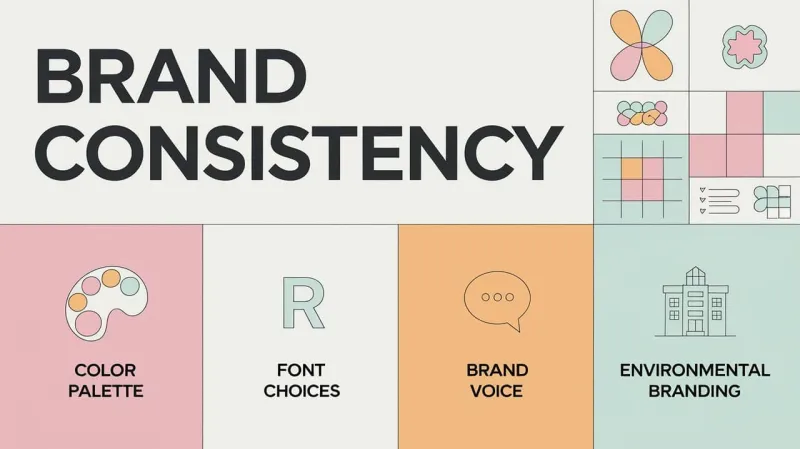
Are the primary and secondary colors consistent, using exact hex or Pantone values rather than approximations? Are typefaces and typographic hierarchies uniform? Are logo versions used correctly and consistently scaled? Does the overall visual tone—the photography style, the illustration approach, the use of white space—feel like it belongs to a single, coherent brand?
Document every deviation. Categorize each instance by severity: minor variations that create subtle inconsistency, moderate discrepancies that a careful observer would notice, and significant divergences that undermine brand recognition entirely. This inventory becomes the foundation for calculating remediation scope and prioritizing effort.
Attaching Numbers to the Problem
The translation from design audit to business case requires connecting specific inconsistencies to specific performance metrics. This is where many organizations stop short, treating design consolidation as a qualitative initiative rather than a quantifiable investment.
For customer-facing inconsistencies, the relevant metrics include conversion rates at key funnel stages, customer-reported trust or confidence scores from post-purchase surveys, and, where A/B testing infrastructure exists, direct measurement of the performance differential between consistent and inconsistent creative. If your email open and click rates have declined over a period during which your email templates became increasingly fragmented, that correlation is worth investigating rigorously.
For internal operational costs, the calculation is more direct. Estimate the hours your team currently spends on asset production tasks that a well-maintained design system would eliminate or dramatically reduce. Apply a fully-loaded hourly rate. The resulting figure is your annual inefficiency cost—and it becomes the baseline against which you evaluate the investment required to build proper infrastructure.
For brand equity, the measurement is less precise but not immeasurable. Customer lifetime value trends, net promoter scores over time, and competitive pricing analysis can all surface evidence of equity erosion or, conversely, demonstrate the compounding returns that accrue when consistency is restored.
The Consolidation Investment: What to Expect
A design consolidation project—the systematic process of auditing existing assets, establishing a coherent design system, rebuilding or updating inconsistent touchpoints, and implementing governance processes to prevent future drift—is not a small undertaking. For most mid-sized businesses, it represents a meaningful investment in both agency or design talent and internal time.
The business case for that investment, however, is typically straightforward once the debt has been properly quantified. Organizations that have undergone rigorous brand consolidation consistently report measurable improvements in conversion performance, significant reductions in the time and cost of ongoing content production, and qualitative improvements in how their brand is perceived by both prospects and existing customers.
Perhaps more importantly, a properly constructed design system—one that includes a living component library, clear documentation, and defined governance processes—does not simply restore the status quo. It creates compounding returns. Every subsequent campaign, every new product launch, every new hire who joins the marketing team operates from a foundation that makes quality consistent and fast rather than a constant negotiation between speed and standards.
The Cost of Waiting
Design debt behaves like financial debt in one particularly important respect: it does not resolve itself. Left unaddressed, fragmented brand systems do not stabilize—they fragment further, as new assets are added by new people referencing existing inconsistent materials as their baseline.
The question for any business carrying significant design debt is not whether to address it, but when. And the honest answer, in most cases, is that the cost of waiting exceeds the cost of acting. Every month that passes is another month of conversion friction, operational inefficiency, and brand equity erosion—expenses that do not appear on any invoice but are no less real for their invisibility.
Bold brands are not built by accident. They are built through deliberate, consistent, and well-maintained visual systems that earn trust at every touchpoint. The businesses that understand this—and act on it—are the ones that find themselves with a genuine competitive advantage rather than a growing liability.